
Key Takeaways:
Discover why the old linear funnel no longer reflects how your customers shop.
Learn the leadership mindset shifts that independent retailers need to make right now.
Get actionable next steps you can start implementing this week to stay visible, relevant, and competitive.
There was a time when a customer walked into a retail store, spoke with a salesperson, selected a product, and purchased it. Maybe they visited two stores first. Maybe they asked a friend. The path was simple enough to draw on a napkin.
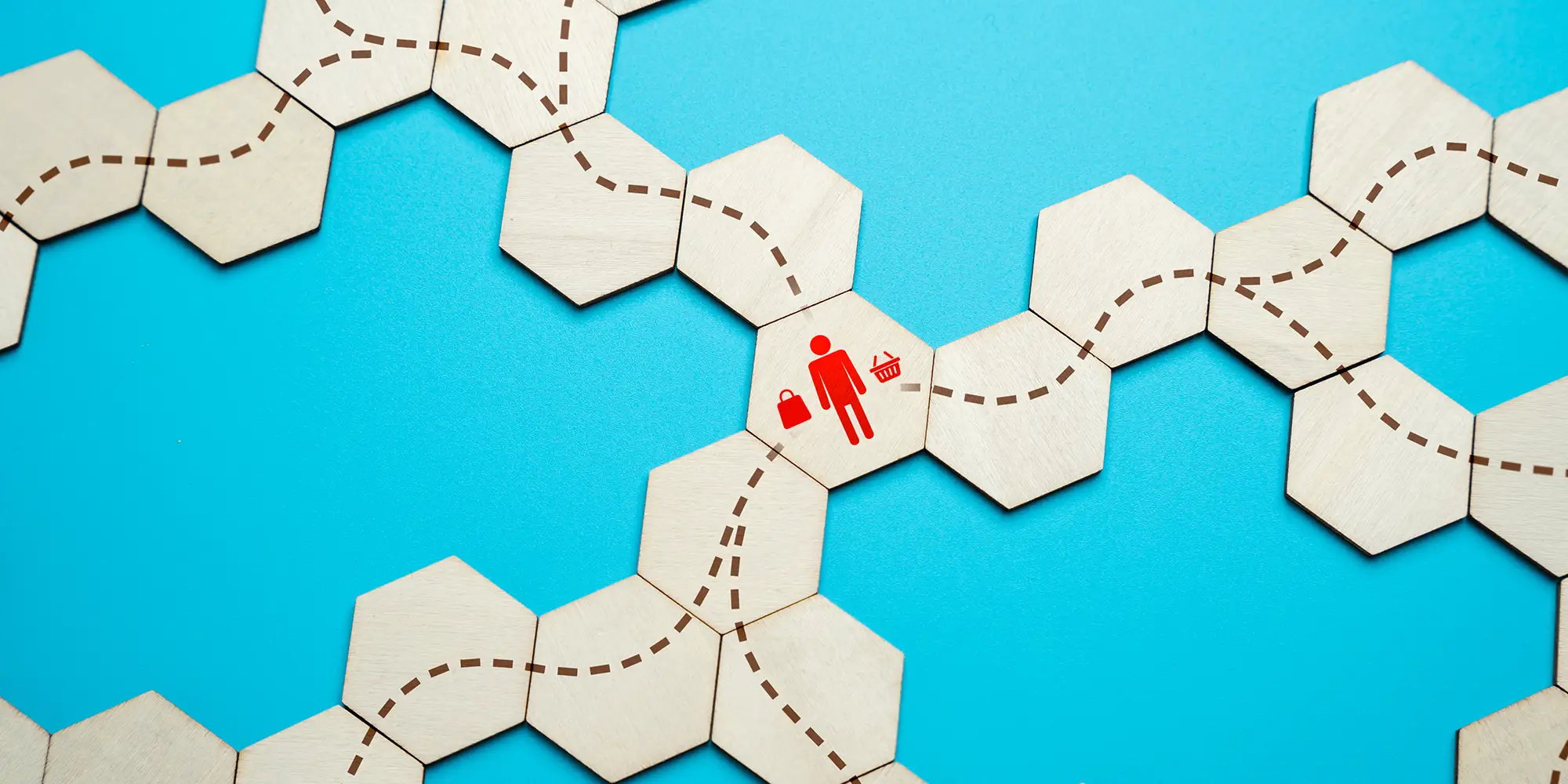
That path no longer exists. Today, before a customer ever walks into your retail store, picks up your hot sauce at a market, or orders your handcrafted accessories online, they have likely scrolled through TikTok, asked ChatGPT for a recommendation, read a dozen Google reviews, visited your Instagram profile, compared your prices on their phone, possibly received a postcard, maybe even asked a friend who asked another friend. The entire journey is nonlinear, deeply personal, and shaped by multiple touchpoints and technology that is accelerating faster than most independent retailers have been able to adapt to.
If your marketing strategy still looks like it did four or five years ago, it is not just outdated. It may be working against you. Here is what the modern buying journey looks like, what needs to change at the leadership level, and the concrete steps you can take right now to meet your customers where they are.
The Buying Journey’s Messy Middle
Google’s behavioral science research, developed alongside The Behavioural Architects, described what most retailers are already experiencing but struggling to name: the messy middle. Rather than moving neatly from awareness to consideration to purchase, today’s consumers cycle continuously between two modes: exploration, where they cast a wide net and discover options, and evaluation, where they narrow those options and compare. They switch between these two modes as many times as needed. The process can take days, weeks, or months. For high-consideration purchases like fine jewelry, luxury accessories, or a premium artisan food product they are considering giving as a gift, the loop tends to be especially long and complex.
Layered on top of this is the collapse of the line between online and in-store. 87% of consumers now use their smartphones to research products while physically in a store. Deloitte’s 2025 research identifies Gen Z as the most authentically omnichannel generation, meaning they do not think in channels. They shop wherever the experience is best. That same pattern is spreading across every age group. Gen X is making more than half of their purchases online. Boomers are using search and retailer websites to research before visiting. The omnichannel customer is no longer generational or a customer segment. It is essentially everyone.
And now we have AI. Adobe Analytics reported that traffic to U.S. eCommerce sites from generative AI sources grew 1,200% in early 2025 compared to just six months prior. During the 2025 holiday season, AI referrals from ChatGPT and Perplexity to eCommerce brands spiked 752% year-over-year. OpenAI launched a shopping research feature in ChatGPT in late 2025 that can research across the internet, pull pricing, gather reviews, and build a personalized buyer’s guide in minutes. AI is not a future trend to keep an eye on. For independent jewelers, luxury boutiques, accessories designers, and emerging food and CPG brands, it is already a front door that a growing number of your customers are walking through, and if your business is not structured to be found there, you are simply not in the conversation.
“1 in 3 consumers will choose their second-choice brand simply because it shows up when they are searching. Presence matters more than perfection”
– Technology Therapy® Group
What Leadership Needs to Change
Understanding the journey and leading your business through it are two entirely different things. The gap between those two is where most independent retailers get stuck. Closing that gap is not a marketing tactic problem. It is a leadership behavior problem that requires specific shifts in how owners and managers operate every day.
Stop thinking in campaigns. Start building systems.
Campaign thinking is one of the most common holdovers from an older retail model. A store plans a Valentine’s Day push, runs it for six weeks, measures sales, and moves on to Mother’s Day. But the modern journey does not operate in campaigns. Customers are continuously looping through discovery and evaluation, without regard for your promotional calendar. What they need from you is consistency, a content engine producing relevant material on an ongoing basis, email sequences that respond to behavior rather than blasting the same message to your entire list, and social profiles that stay active between campaigns, not just during them.
Stop treating online and in-store as separate strategies.
Your customer does not see channels. They see one brand. When the Instagram account for your jewelry store showcases bold, fashion-forward pieces, but the website looks like it was built and functions like it was in 2020, and the email newsletter lacks value or substance, customers experience dissonance. That dissonance erodes trust faster than almost anything else. Research shows that omnichannel customers who engage across multiple coordinated channels purchase 250% more frequently and spend 15-30% more annually than single-channel customers. Unified communication is not a nice-to-have. It is a direct driver of revenue.
Lead with listening, not broadcasting.
The old model was built on the idea that you crafted the message, pushed it out, and hoped it stuck. Today, the most effective independent retailers listen first. They pay attention to what customers say in reviews, direct messages, and at the counter. They notice which products are saved, shared, or asked about. For a fine jewelry store where engagement ring shoppers consistently raise questions about lab-grown diamonds and sustainability, that is not just a trend to note. It is a signal to adjust everything: website copy, sales floor dialogue, social content, and email strategy. Personalization is not a technology problem. It is a listening, planning, and behavioral problem.
Actionable Next Steps You Can Take Now
Knowing the journey has changed is only useful if it changes what you do. These steps are designed for independent retailers working with real-world budgets and small teams, and they are ordered to give you the fastest impact first.
1. Audit what you actually know about your customers, versus what you assume.
Most independent retailers hold assumptions about their customers that have never been tested or validated against real data. Pull your POS system, your email list, your website analytics, and your social media insights. Look at who is buying, not who you picture in your head. This is where observational data will help you. Talk to your frontline team, your sales associates hear things every day that never make it into a strategy conversation (observational data). Schedule 15 minutes a week or 30 minutes a month to discuss what customers are asking about, the objections they raise, the competitors they mention, and the channels they say they found you through, even if a final purchase is not made. So often, stores ask for only some of this when customers check out. Keep a pad or reMarkable behind the counter and reward team members for tracking this data. Then review your Google reviews and social comments as unfiltered customer voices. These conversations are the richest persona data a small retailer has.
2. Map the trigger and the research path, not just the demographic.
The old persona model asked, “Who is your customer?” The modern model asks how they buy. For a jewelry store, an engagement ring buyer may begin their search months before they ever visit a store. Their trigger is the decision to propose. A Gen Z self-purchaser might discover your brand on TikTok, migrate to Instagram for brand exploration, check Google reviews, ask perplexing questions, and then visit in person. A Boomer anniversary buyer might start with a Google search, review your Facebook, read Google reviews, ask a trusted friend, and then visit one or two stores. Mapping the actual research path for each customer type tells you where to invest your marketing dollars and what content to create for the customers driving your revenue.
3. Optimize your Local & Digital Listings
These tools are free and extremely impactful, yet they remain chronically underused by independent retailers. Ensure your profile includes a detailed business description written in the language your customers use when searching. Make sure this is consistent across Google Business, Bing, Yelp, and any other digital profiles. Upload high-quality photos monthly: product shots, store interior, team, and customer experience. Post updates regularly. Actively respond to every review as quickly as possible, but at least within 48 hours—positive and negative. Reviews are among the most trusted discovery signals across generations, and they are increasingly what AI tools like ChatGPT and Google AI Overviews rely on when recommending businesses.
4. Create content that answers the questions people have during exploration and evaluation searches.
For a fine jewelry retailer, those questions might include how to choose an engagement ring, what the difference is between lab-grown and natural diamonds, or how much to spend on an anniversary gift. For an emerging hot sauce brand or an artisan candy maker, they might have questions about pairings, ingredients, or gift ideas for foodies. Each of those queries is a discovery-stage opportunity, a chance to be found, i.e., explored. Blog posts, short videos, and website FAQ pages that answer the questions thoroughly as people bounce between phases will help your business on many fronts: they help you rank in traditional search, and they give AI tools useful information to reference when making recommendations. Pair this with combined efforts on social media and other platforms you’ll build a clear and consistent experience for your customers.
“Your customers do not see channels. They see one brand. Consistency across every touchpoint is not a nice-to-have; it is what builds trust.””
– Technology Therapy® Group
The Businesses That Adapt Now Will Have a Real Advantage
Between 2022 and 2024, the luxury market lost approximately 50 million customers globally. That is not just an economic story. It is a story about businesses that lost the ability to meet customers where they were. Independent retailers in jewelry, luxury accessories, and emerging consumer goods are not immune to these forces, but they also have an advantage that larger competitors struggle to match: the ability to be genuinely personal, responsive, and human at every touchpoint.
The buying journey has changed. The customers who would love what you offer are still out there. They are just taking a longer, more complex, more digitally mediated path to find you. The retailers who adapt their strategy to that reality, who invest in discoverability, who listen before they broadcast, who build systems instead of running campaigns, are the ones who will capture that attention and turn it into lasting relationships.
You do not have to do all of this at once. Start with one step. Audit your assumptions. Update your digital profiles. Map the buying trigger for your best customer type. Small, consistent actions compounded over time are how independent retailers compete and win.
Ready to Rethink Your Strategy?
If you’re unsure whether your current marketing strategy reflects today’s omnichannel, AI-influenced reality, it’s time for a conversation. Book an appointment with our team to review your marketing needs, identify gaps, and build a plan that keeps your business visible, relevant, and competitive.