

Key Takeaways:
Facebook now supports product reviews in Commerce Manager, which directly feeds Meta’s new AI-powered shopping pop-ups.
Google AI Overviews appear on 83% of “best product” searches, and review volume and distribution are key signals for whether your products get cited.
Retailers should audit review schema, product feed data, and FTC compliance within the next 90 days.
Reviews are no longer just social proof on a product page. They are machine-readable data that AI systems use to decide what to show, recommend, and sell.
On February 1, a notice appeared in my inbox from Facebook with the subject line, “Build trust with customers by allowing syncing of product reviews and Q&A.”
The opening of the email reads:
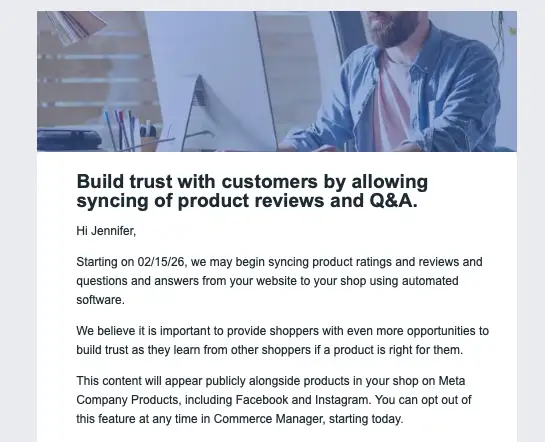
“Starting on 02/15/26, we may begin syncing product ratings and reviews, questions, and answers from your website to your shop using automated software.
We believe it is important to provide shoppers with even more opportunities to build trust as they learn from other shoppers if a product is right for them.
This content will appear publicly alongside products in your shop on Meta Company Products, including Facebook and Instagram. You can opt out of this feature at any time in Commerce Manager, starting today.”
This message may have been sent to you or your admin on your Facebook / Meta Business suite.
This notification may seem like a small or a “nice feature” update, but it’s a signal that every major platform is now building AI systems that read, summarize, and act on your reviews before a shopper ever asks a question.
Google is doing it.
Meta is doing it.
Amazon is doing it.
ChatGPT and Perplexity are doing it.
The way you collect, distribute, and maintain your reviews is no longer a customer service consideration. It is the infrastructure your business visibility runs on in 2026.
What Is Actually Happening When a Customer Searches Now
Think about what a customer sees when they search “best ” on Google today. In 83% of those searches, an AI Overview appears above the regular results. That AI is not guessing. It is reading review data, product descriptions, ratings, and structured markup from across the web and deciding which products and brands to surface.
Brands cited in an AI Overview get 35% more organic clicks than those that are not cited. For independent retailers competing against national brands with larger budgets, this is where the gap either widens or closes. The variable in your control is the quality and breadth of your review presence.
This changes how you should think about collecting reviews. For local retail brick-and-mortar businesses, it is no longer just about looking credible on Google Business; now your product pages need reviews. These product detail pages need to be readable by machines across multiple platforms simultaneously.
The Platforms You Need to Be Thinking About
Facebook and Meta
At Shoptalk 2026, Meta announced an AI feature that displays a pop-up after a shopper clicks your ad. That pop-up includes review summaries, brand details, and a Buy Now button, all without the shopper visiting your site. Checkout happens through Stripe and PayPal integrations.
Here is what that means for your retail business:
If your Facebook product catalog is thin or your reviews are sparse or non-existent, the AI has very little to work with or nothing at all. It will either show weak information or surface a competitor who has done the work. Meta pulling reviews from Facebook Commerce Manager is not a future possibility. It is the architecture they just released.
The immediate action to consider:
Check your Meta Commerce Manager product catalog to see if the data is complete. And if your site is missing product reviews, install a system to start collecting reviews on the platform for every purchase.
Note – if you’re already using Klaviyo for your email marketing, they offer an easy-to-add integration for post-purchase emails that lets you request product reviews.

Image Credit: Meta
Google and AI Overviews
Google’s March 2026 core update changed how schema markup works in a meaningful way. Schema is no longer just a mechanism for getting star ratings in search results. AI Mode now uses structured data as a signal for entity verification when deciding which sources to cite.
This means your AggregateRating schema must reflect at least 5 genuine, verifiable reviews per product. Any schema that does not match what is actually on the page gets demoted. Make sure to run the Google Rich Results Test on your key product pages this week. Products with accurate star ratings in search earn 10% to 17% higher click-through rates, and that number matters only if your schema is correct.
AI Shopping Agents
This is the shift with the longest runway but the highest stakes. ChatGPT now supports instant checkout through Stripe. Perplexity has partnered with PayPal for direct purchases. Google launched a “Buy for me” feature inside AI Mode. Morgan Stanley projects that AI agents will handle 10 to 20% of eCommerce volume in the near term.
These agents skip products with incomplete data. There is no second chance. If your product detail page has:
- Vague titles
- Descriptions that are minimal and low quality
- Missing pricing
- Out-of-date inventory
Your business and products will not appear.
The agents are reading product feeds the same way Google reads your website. Structure and completeness are prerequisites for inclusion at all.
Shopify’s Winter ’26 Edition introduced what they are calling Agentic Storefronts, which are product architectures designed specifically so that AI systems can understand products and intent.
If you are on Shopify, this is the direction your product data should be moving.
What to Do in the Next 90 Days
Enrich your product feed now. Go into your product listings and make sure every field is complete:
- Detailed titles with specific attributes
- Thorough descriptions with use-case language (ask us about creating your own unique custom GPT for writing descriptions)
- Accurate pricing
- Real-time inventory
- High-quality images (don’t forget the alt tags)
- Add Q&A sections to your products pages
These updates will improve your visibility across Google, Meta, and AI shopping agents, plus the human shoppers really appreciate these features.
Audit your review schema on every product page. Run the Google Rich Results Test to verify that your AggregateRating and Review schema are correctly formatted and match the actual review content. Google provides a free tool called the Rich Results Test, which lets you enter any product page URL on your website. It shows whether Google can interpret the review data on that page, including star ratings, review counts, and review text.
If you are on Shopify, apps like Judge.me generate this schema automatically, but you should verify that it is rendering correctly.
Set up product reviews in Facebook Commerce Manager. This is the timely action given Meta’s new AI shopping features. Connect your product catalog, enable the review flow, and begin collecting reviews from Facebook and Instagram purchasers. This feeds directly into the AI-powered pop-up Meta has started rolling out.
The Thread Running Through All of This
For many eCommerce sites, reviews used to appear only on the company’s product pages. They served as social proof for shoppers who were already on your site and considering a purchase.
That is not where they live anymore. They will now live on more platforms.
Every platform covered here, Google, Meta, ChatGPT, Perplexity, is building systems that read and act on review data before the shopper types their first word. The reviews you collect today are being fed into ranking algorithms, AI summaries, and purchase-completion tools that operate entirely outside your website.
Now is the time to build a strong, compliant, distributed review presence across platforms, which is not a marketing project. It is infrastructure. The retail and eCommerce stores that treat it that way in the next six months will have a meaningful advantage over those that catch up later.
Is Your Business Showing Up in AI Search?
AI tools are shaping how customers discover products, and your visibility depends on more than traditional SEO. Our AI Search Visibility Audit shows you where you stand and what to adjust so your business appears when it matters most.