

Many independent retailers treat the product detail page (PDP) like a product on a digital shelf, with only a label: a photo, a name, a price, and an “Add to Cart” button. That approach has not worked for some time, but unless your mission was to sell only online, many stores did not invest in what was needed. Their online store supported their primary focus in-store. Your PDP has always had the opportunity to help improve your business’s search, but now it’s the moment of truth in a purchasing journey that spans search engines, social platforms, AI agents, and in-store visits. It does not just need to inform; it needs to convert, share, index, and connect.
The retailers who understand this are building product pages that function as complete conversion systems. The retailers who do not will lose sales, and now they’re going to lose the ability to be found not only by online shoppers but also by local ones.
Here is what every independent retailer needs on every product detail page today:
1. High-Impact Visuals and Mobile-First Presentation
Visual quality is the most direct driver of conversion on a product detail page, and the data is unambiguous. High-quality product images produce a 94% higher conversion rate than low-quality visuals, according to a 2024 eCommerce analytics compilation. Separately, 67% of consumers rank image quality as the most important factor when researching a product online, rating it above product descriptions and customer reviews.
For independent jewelers and specialty retailers, this is even more crucial, especially when customers purchase based on emotion rather than logic. When a customer can’t hold a product, the image must substitute for touch. Multiple views, close-up details, accurate color representation, lifestyle context, and on-model sense of size and scale are not optional; they are essential. Product pages with multiple views through a slideshow see 65% higher conversion rates than those with just a single image.
Video is the fastest-growing format on product pages, and for good reason. Product pages with video raise conversions by up to 80%, and 83% of consumers say a product video has influenced their decision to purchase (Wyzowl, 2025). A 15-second clip showing a piece of jewelry in motion, catching light from multiple angles, delivers information that no still image can. Or a quick video demonstrating the features or styling capabilities will give the buyer or the gift-giver confidence in their purchase.
Mobile is no longer the secondary channel. As of December 2025, mobile accounts for 54% of global eCommerce traffic. If your product images do not load fast, are not clear at thumbnail size, and do not support zoom and swipe interaction, you are losing more than half your potential customers before they evaluate your product.
Practical Checklist
- Minimum 4 to 6 images per product, including detail shots and a lifestyle image. (Stay consistent here, don’t do 4 on some and 6 on others)
- Video on high-consideration products, especially those priced above $500 or products where features are the big selling point (backpacks, handbags, multi-length necklaces)
- Descriptive alt text on every image, both for accessibility and search indexing
- Zoom functionality enabled on desktop, swipe-optimized on mobile
- Mobile page load time under 3 seconds
2. Social Proof and User-Generated Content
The second requirement for a high-performing PDP is social proof, and specifically, social proof that customers can interact with. Shoppers want to see how real customers experience your products, and when they can, conversion rates jump significantly.
Visitors who interact with user-generated content (UGC) on product pages convert 102% more than the average site visitor (Statista/Shopify analysis, confirmed across multiple 2025 studies). Just 10 product reviews can lift conversion rates by 45% (Bazaarvoice, 2023). And 88% of consumers actively seek reviews before making a purchase.
For jewelry and accessories retailers, the stakes are especially high. Shoppers buying high-consideration, meaningful items want reassurance from people who have made the same decision. A review that mentions how a necklace held up over a year of daily wear closes more sales than any marketing copy you can write.
What to Include on Every Product Page
- Star ratings and written reviews, ideally with the ability for customers to submit photos or videos alongside their text
- A Q&A section that addresses common purchase hesitations, including sizing, materials, care instructions, and customization options
- Shoppable UGC galleries where available, linking customer-submitted photos back to the product
The Q&A element deserves particular attention. It reduces pre-purchase friction for new visitors and, as covered in Section 4, makes your product data more legible to AI systems at the same time.
3. Conversion and Trust Signals
A customer can be interested in your product and still abandon the page. The most common cause is not price; it is uncertainty. Unexpected shipping costs cause 48% of cart abandonments, according to the Baymard Institute. Clear return policies and trust badges reduce cart abandonment by up to 28% (Triple Whale, 2025). Consumers spend 51% more with retailers they trust (Forter, 2024).
Independent retailers have a strategic edge over large-scale eCommerce competitors in this area: they can be personalized and human, whereas national sites tend to be generic. (Note larger retail stores are starting to use data to improve personalization and this will not stay an opportunity forever.)
Trust Elements for Product Pages
- Pricing transparency. Show the full cost, including any customization fees, engraving charges, or relevant notes about sizing, upfront. Price surprises at checkout are among the top reasons customers do not return.
- Shipping and delivery information. State your shipping speed and any free shipping thresholds directly on the product page. Do not make customers hunt for this elsewhere.
- Return and exchange policy. Include a brief, plainly written summary directly on the page. “Free returns within 30 days” is a conversion statement as much as it is a policy.
- Security and payment indicators. Accepted payment methods, secure checkout, and recognized trust badges are particularly important in luxury and jewelry categories where transaction values are high and first-time buyers carry risk anxiety.
- Direct contact or consultation option. A visible live chat, contact link, or booking option, or Call Us button on the product page can close high-consideration sales that a static page alone cannot. The ability to provide a direct human touchpoint at the moment of decision reassures your buyers.
4. AI-Readable Product Data
Your product detail page is no longer read only by humans. AI systems on Google, Meta, ChatGPT, and Perplexity are now reading, summarizing, and acting on your product data as a precondition for whether your products appear in AI-powered search results, shopping pop-ups, and agentic purchasing flows.
We covered the platform-by-platform details in our article Product Reviews Are Now a Must-Have for Retailers to Stay Competitive. The key takeaway for your PDP: incomplete or vague product data is the fastest way to become invisible to AI commerce systems.
Google AI Overviews now appear on 83% of searches for ‘best product’ queries. Products cited in those overviews receive 35% more organic clicks than those that are not. The criteria for citation include:
- Review volume
- Accurate structured data
- Proper product feed set-up and information
AI shopping agents, including ChatGPT’s Stripe-integrated checkout, Perplexity’s PayPal partnership, and Google’s ‘Buy for me’ feature, skip products with incomplete data. There is no second chance. Morgan Stanley projects that AI agents will handle 10 to 20% of eCommerce volume in the near term.
What AI Readiness Requires on Your Product Pages
- Attribute-rich product titles. “Platinum Diamond Pave Band Ring, 0.25 ctw, Size 6” outperforms “Silver Ring” in every AI-readable context. Specificity is the currency of AI visibility.
- Use-case product descriptions. “Designed for daily wear with a low-profile setting” gives AI systems the semantic context to match your product to the right queries. Descriptions built only for aesthetics do not perform in AI-indexed environments.
- Current, accurate specifications. Pricing, inventory status, dimensions, and materials must be up to date. AI systems read product feeds the way Google reads your website. Stale or inconsistent data is filtered out.
- Verified review schema. Run Google’s free Rich Results Test on your key product pages to confirm your AggregateRating schema is rendering correctly. Products with accurate star ratings in search earn 10 to 17% higher click-through rates.
- Q&A sections. These contribute to the natural-language context AI systems use when summarizing products. They also directly address the questions AI shopping agents are trained to evaluate.
If you are on Shopify, your native product data architecture will automatically generate the schema, though you should verify that it renders correctly. Shopify’s Winter 2026 Edition introduced Agentic Storefronts, product architectures designed to enable AI systems to understand and transact against your catalog.
5. Brand Values and the Story Behind the Product
Product specifications tell a shopper what they are buying. Brand values tell them why it matters. These are not the same conversation, and the data shows consumers increasingly want both.
Sustainability is a critical factor in purchasing decisions for 64% of consumers’ purchasing decisions globally (Capgemini, 2025). PwC’s 2024 Voice of the Consumer Survey found that consumers are willing to pay an average premium of 9.7% for sustainably sourced or produced goods. For jewelry specifically, sourcing transparency, recycled metals, ethical stone certification, and local artisan partnerships are conversion-relevant information, not just marketing add-ons.
The same principle applies to community, inclusivity, and the story behind the maker or design. These elements influence purchasing decisions, especially for Millennial and Gen Z consumers who now make up the majority of retail spending growth. However, presenting this information on a product detail page requires precision. A heavy-handed values section can seem performative. The best way is to be specific: a single line or badge about metal or stone sourcing, a brief note on the maker’s craft, or a certification from a reputable partner the shopper can verify.
What to Consider Including
- Material sourcing or origin information where verifiable, such as recycled gold, ethically sourced gemstones, or handcrafted provenance
- Certification badges from recognized third parties, including the Responsible Jewellery Council or relevant fair trade organizations
- A brief ‘Why this piece’ or ‘The story’ section that explains design inspiration, artisan background, or community connection
- Sustainability commitments stated in factual, measurable terms rather than aspirational marketing language
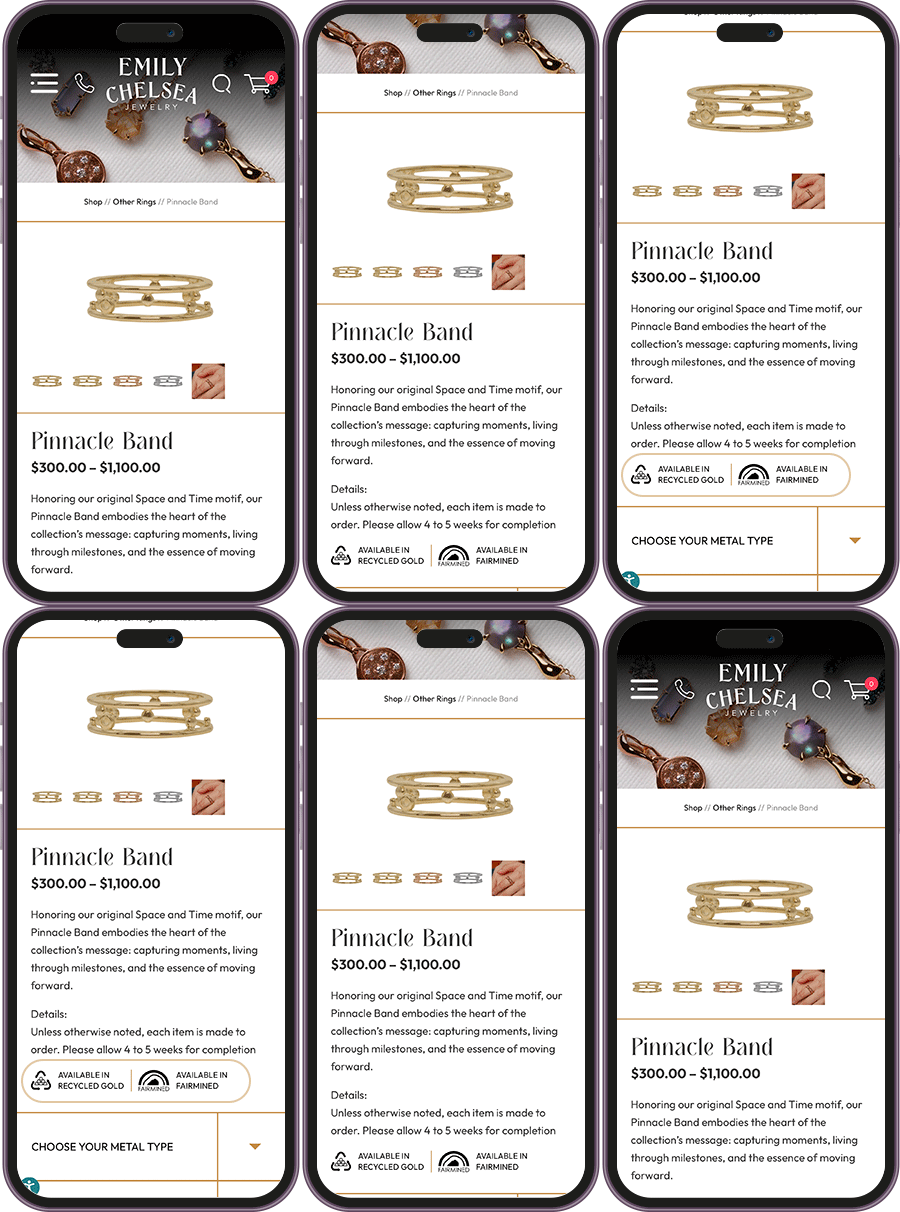
A critical caution: 57% of consumers believe brands are guilty of greenwashing, according to Simon-Kucher’s 2024 Global Sustainability Study. Specificity and verifiability are the difference between trust-building and backlash. If you cannot back a claim with a certification or sourced fact, do not make it.
It’s Time to Invest in Your Product Detail Pages
The average eCommerce product page converts at 1.5% to 3%. Top-performing stores achieve 4% to 8%, a difference that compounds across every product in your catalog. For a retailer generating $500,000 in annual online revenue, moving from a 2% to a 4% conversion rate while holding traffic constant doubles online revenue without a single additional dollar in advertising spend.
The five elements in this article are the mechanics behind that gap:
- Visual quality closes the inspection deficit that every online retailer faces against a brick-and-mortar competitor.
- Social proof reduces purchase risk for customers who have never bought from you before.
- Trust signals eliminate the checkout friction that causes abandoned carts.
- AI-readable data determines whether your products exist at all in the emerging channels where customers are increasingly beginning their purchasing journeys.
- Brand values create the connection that turns a first-time buyer into a repeat customer and an advocate.
None of this requires a large agency or a six-figure budget. It requires intention and a systematic approach. Build your product detail pages like they are the hardest-working sales tool in your business, because they are.
Schedule a free consultation to learn how we can help you and your team. We have created custom GPTs that meet these requirements while maintaining your brand voice, making this process easier and faster.