
Key Takeaways:
You don’t have to promote every holiday, so choose the dates that fit your audience and skip the rest.
AI tools now find deals for shoppers all season, so being easy to find matters more than any single sale.
Too many promotions can train customers to wait for discounts and weaken your brand.
Every November, business owners face the same question: should we run a promotion for every shopping holiday? The short answer is no. This guide walks through the major promotional dates of the 2026 holiday season, what each was built for, and how to decide which ones fit your brand. Some of the most successful businesses we work with skip certain holidays entirely and still have a strong season.
How These Shopping Holidays Were Born
These dates weren’t handed down by tradition. They came from an unlikely mix of sources: police traffic reports, a credit card marketing campaign, a retail trade group, and a New York community center working with the United Nations Foundation. Yet nearly every business now plans its season around them.
If the calendar was invented, you get to decide which parts of it serve your business.
“Black Friday has traditionally been more geared toward mall retailers selling in volume than to smaller, independent brands. Several jewelers I work with skip it entirely. Their customers are high-end, and a doorbuster discount would work against everything their brand stands for.“
– Jennifer Shaheen
President and Founder, Technology Therapy® Group
Black Friday: Built for the Mall, Not for Every Brand
The name has a surprisingly gritty origin. In the early 1960s, Philadelphia police started calling the day after Thanksgiving “Black Friday” because of the chaos caused by crowds of suburban shoppers coming into the city. Officers worked long shifts handling traffic jams, accidents, and shoplifting. Local merchants tried to rebrand it as “Big Friday”, but the name didn’t stick.
In the 1980s, retailers offered a more flattering explanation: Black Friday was the day holiday sales pushed stores from “in the red” (losing money) to “in the black” (turning a profit).
For years, the day delivered real frenzy. In 1983, some shoppers fought each other in stores to get Cabbage Patch Kids. In 1996, Tyco sold a million Tickle Me Elmos in a single holiday season. In 1998, Furby was meant to sell for about $30, but shortages pushed online prices to $200 or more. The rush continued into the 2000s: the Nintendo Wii and PlayStation 3 launched in 2006, and the Zhu Zhu Pets craze hit in 2009.
That kind of frenzy is harder to create when the same product is one click away. Now AI tools are finding deals for shoppers, making the doorbuster dash even less necessary (more on that below).
Before you commit, ask yourself:
- Does my audience shop based on price?
- Can my margins absorb a discount?
- Does a sale fit how I want my brand to be seen?
If you answered no, then skipping Black Friday is a smart choice. You can offer a gift with purchase or an exclusive preview instead (or simply let your competitors fight over the noise).
Small Business Saturday: The Most Underused Date on the Calendar
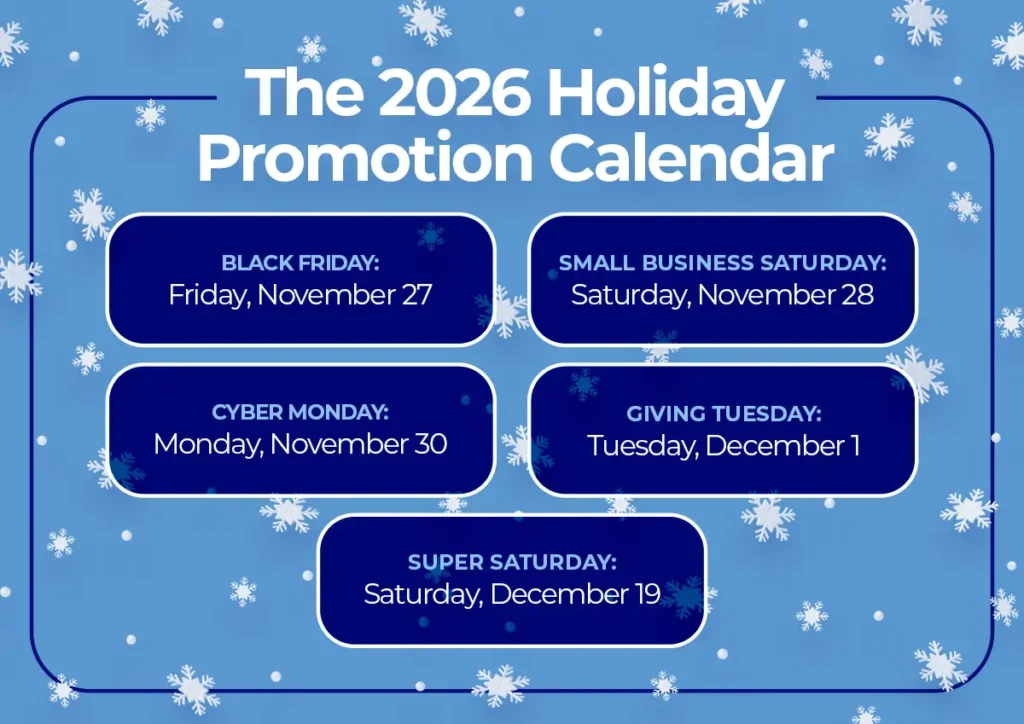
American Express created Small Business Saturday in 2010 to steer holiday shopping toward local businesses, many of which were struggling in the recession. The SBA has co-sponsored it since 2011, and by 2012, officials in all 50 states were taking part.
Consumers know about this day, but in our experience, too few small businesses make the most of it. A reminder email or social post the week before goes a long way. Make your offer available online as well, so customers can support you without being pushed to leave the house. It works especially well in walkable downtowns and town centers, where shopping local can turn into a full afternoon out.
Cyber Monday: Now More of a “Cyber Week”
The National Retail Federation coined “Cyber Monday” in 2005, after noticing that people kept shopping online at work the Monday after Thanksgiving. Back then, office internet was often faster than home internet.
Today, Cyber Monday has blended into Black Friday, and deals seem to start earlier every year, with holiday promotions reaching shoppers long before Black Friday. Deloitte’s 2026 Holiday Retail Survey found that June promotions had already captured some holiday purchases for one in four shoppers, while 22% said they would begin shopping sooner than last year.
If you’re already running a Black Friday offer, decide whether Cyber Monday will extend it, add an online-only twist, or give your email list a rest. Repeating the same message two or three times in one week wears out your audience quickly.
Giving Tuesday: A Pause for Generosity
Giving Tuesday is the season’s built-in counterbalance to all the shopping. It was created in 2012 at New York’s 92nd Street Y and its Belfer Center for Innovation & Social Impact. It was founded by Henry Timms, who was then the 92nd Street Y’s executive director, and the United Nations Foundation joined as a co-founding partner. It’s a chance to connect your brand with a cause your customers care about, without selling anything.
Super Saturday and the Final Stretch
Here’s a twist on the Black Friday legend: Britannica notes that most stores actually saw their biggest sales on the Saturday before Christmas. In 2026, that’s December 19.
The final stretch rewards helpful messages over discounts. Send reminders about shipping cutoffs, in-store pickup, holiday hours, and gift cards for last-minute shoppers.
How AI Shopping Tools Are Changing the Entire Holiday Season
The Black Friday frenzy used to depend on being in the right store at the right time. Today, many shoppers let AI tools do the hunting: comparing products, tracking prices, and sending automatic price-drop alerts.
Some recent stats show the impact AI has had on consumer shopping in the past couple of years and as we head into the 2026 holiday shopping season. On Black Friday 2025, Americans spent $11.8 billion online, as confirmed by Adobe. This 9.1% increase from 2024’s Black Friday stats is largely attributed to the rise in AI-powered shopping. Adobe also predicts that AI-assisted shopping will increase 130% over the 2026 holiday shopping season compared with last year’s stats.
For businesses, this means a holiday deal doesn’t need to be linked to a famous date like Black Friday or Cyber Monday to be found. Shoppers are more likely to discover you through clear product information and a trustworthy website than through a doorbuster countdown. As we tell clients here at TTG, being visible to AI tools all season matters as much as any single sale.
“AI has changed the significance of traditional holiday promos like Black Friday and Cyber Monday. Shoppers are more likely to discover you through clear product information and a trustworthy website than through a doorbuster countdown.“
Technology Therapy® Group
Why Over-Promoting Hurts Your Brand
When every holiday brings a new sale, customers learn to wait for the next discount. Your email list gets tired, and a premium brand starts to look like a bargain brand.
Ditch the Over-Promoting, Adopt a Simpler Approach:
- Choose the one or two dates that fit your audience best.
- Commit fully to those.
- Skip the rest with confidence.
Build a Holiday Calendar That Works for You
These shopping holidays were invented, which means you get to decide which ones belong on your calendar. After all, no one knows your brand and your customers’ shopping behaviors better than you do. The right plan should feel true to your brand, not like a race to match everyone else’s sales.
Plan a Holiday Season That Fits Your Brand
You don’t have to promote every holiday, just the right ones. Our coaches will help you build a promotional calendar that matches your audience, your margins, and your brand.