

Key Takeaways:
Understand why specific, credible stories matter when holiday shoppers are choosing carefully.
Start with the customer’s holiday, then choose products that fit.
Find story material already inside your business.
Carry one story across every channel with a clear next step.
Take a look at your holiday marketing calendar. Does it look something like this?
Monday: New arrivals.
Wednesday: A featured product.
Friday: A discount.
Sunday: Another reminder to shop.
There’s plenty of activity on your calendar. But are those messages giving customers a reason to choose your business or simply reminding them to shop? During the holidays, what you say matters just as much as how often you say it.
Compare these two messages from a gift retailer:
- Product-First: “Our holiday candle collection is here.”
- Story-Led: “Light a balsam and cedar candle before guests arrive, and your home will smell like the holidays the moment they walk in.”
Both messages feature the same product, but the second helps customers picture how it fits into their holiday celebrations.
That’s the power of holiday storytelling. We’re not suggesting you stop featuring products and promotions, but a story helps customers connect what you sell to the people, moments, and traditions that matter to them and gives them a more personal reason to buy.
Why Storytelling Matters This Holiday Season
Shoppers haven’t stopped celebrating, but they are choosing carefully. Circana’s 2026 holiday study found that 74% of U.S. consumers plan to use money-saving tactics this season, yet shoppers are also drawn to gifts that combine practical use with personal meaning.
A discount can explain why someone should buy today. Your story explains why this is the right gift in the first place. (We explored this shift Why the Lowest Price Isn’t Winning You the Sale.)
Storytelling also creates an opportunity to build trust. In a Gartner survey released in September, 57% of consumers reported that AI-generated content has lowered their trust in brand messaging overall.
Independent retailers have an advantage here.Competitors can’t easily copy the specific knowledge inside your business: why your buyer chose a collection, which questions shoppers ask, or the detail a maker can explain. Stories built around that firsthand knowledge help customers understand what makes your business different.
“A discount can explain why someone should buy today. Your story explains why this is the right gift and the right place to buy from.“
– Jennifer Shaheen
President and Founder, Technology Therapy® Group
Start with the Customer’s Seasonal Needs, Not Your Inventory
It’s natural to plan around what you need to sell. Instead, start with the customer’s situation, then choose the products that fit.
Ask your team:
- Who is shopping, and who will receive the item?
- What do they want the gift to communicate?
- Are they continuing a tradition or starting a new one?
- What could make choosing difficult?
That last question is especially important. Perhaps the shopper wants something personal on a limited budget. When you help them work through that decision, your expertise becomes part of the story.
“Gifts under $100” answers a budget question. “A thoughtful thank-you for the person who always shows up” helps customers recognize purpose. You can use both.
Not everyone’s holiday looks the same. Leave room for chosen family, long-distance relationships, quiet celebrations, and people creating traditions of their own.
Find the Stories Unique to Your Business
You don’t need a production crew or a dramatic brand history. In our recent blog on runway lessons for independent retailers, we explored how makers, purpose, and everyday use can give products a story.
Listen to Customer Questions
Comments like “she’s impossible to shop for” or “this is our first holiday in our new house” each point to a situation your marketing can address. Notice the exact words customers use, too. When someone calls a gift “something she’d never buy for herself,” that tells you the shopper wants to give something special the recipient might not choose on their own.
Explain Why You Chose a Product
Go beyond “We love this!” Does an item solve a problem that shoppers regularly describe? The useful detail is often small, like a serving bowl that goes from oven to table or a necklace that adjusts from short to long. Share details about the maker or craftsmanship behind a piece so customers understand what makes it special and who they’re supporting.
Bring Your Team into the Story
Ask a team member how they would choose a gift for a particular kind of person. The most useful part isn’t their favorite product. It’s their reasoning.
AI tools can help you polish these ideas, but the raw material has to come from you. (We explored this idea further in What It Takes to Be Creative in an AI-First World.)
Give the Product a Role in What Happens Next
According to Deloitte’s 2026 Holiday Retail Survey, 50% of holiday shoppers intend to gift an experience this year (compared with 47% in 2025 and 39% in 2024), and 79% of those shoppers want to pair it with something physical.
A product doesn’t have to compete with an experience. It can become part of it.
Imagine a kitchen store helping someone choose a gift for a parent who loves to cook. Instead of suggesting another gadget, the store helps the shopper pair a cookbook with a beautiful baking dish and a plan to make one of the recipes together. Now the gift includes an experience they’re both looking forward to, with each product playing a meaningful role.
Turn a Product Promotion into a Story
Here are three hypothetical examples:
- Jewelry
Product-first: “Shop our initial necklaces.”
Story-led: “For the grandmother welcoming another name into the family, a new initial can mark a new chapter. Explore necklaces you can personalize with the people she holds close.” - Home & Gifts
Product-first: “Holiday entertaining essentials have arrived.”
Story-led: “Your first holiday table doesn’t need matching everything. Start with one piece you love, add the dishes you already own, and make room for everyone. Explore serving pieces for your first year hosting.” - Apparel & Accessories
Product-first: “New winter scarves are here.”
Story-led: “She’s always the first to suggest a winter walk and the last to head inside. Choose a scarf in a color she’ll reach for long after the decorations come down.”
Make these directions your own with accurate product details and real observations from your customers.
“In a story-led message, the product supports the relationship. It doesn’t replace it.“
– Jennifer Shaheen
President and Founder, Technology Therapy® Group
Carry One Story Across Your Marketing
Once you have a strong idea, give it room to grow. A November theme like “Gifts that say, ‘I noticed'” could guide:
- An email about remembering the small things someone mentions
- A short staff video explaining a thoughtful gift recommendation
- A website collection organized around interests rather than generic recipient labels
- An in-store sign asking, “What does your person love doing?”
Each channel should add something useful while telling a consistent story, whether shoppers discover it through email, your website, social media, or your store. (For more ideas, see 3 Quick Personalization Wins for Your Holiday Marketing.)
Don’t overlook your physical store. PwC’s Holiday Outlook 2026 found that more than half of consumers (52%) plan to go into physical stores to figure out what to give. When your team asks what a shopper already has and helps fill the gaps, the story comes to life.
Give Your Story a Clear Next Step
Storytelling isn’t a request to stop selling. Customers still need prices, availability, delivery details, and a clear way to buy. Connect your story to a practical next step, such as shopping a collection, booking a gifting appointment, or ordering personalization before the cutoff.
Resist adding urgency just because it sounds persuasive. Use real deadlines, accurate availability, and offers that apply to the products you’re featuring.
Review Your Next Three Holiday Messages
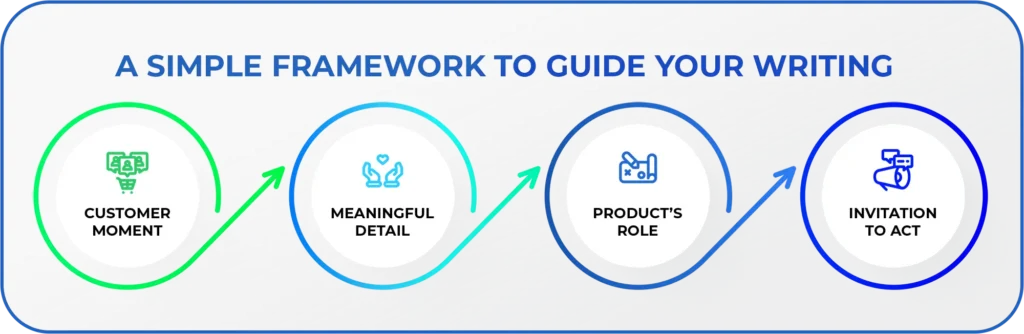
You don’t need to rebuild your holiday plan. For each of your next three messages, ask:
- What customer moment does this connect to?
- What specific, truthful detail makes this story unique to your business?
- What role does the product play?
- What should the customer do next?
Quick Check: Ask a team member to review the message without any explanation from you. If they can describe who it’s for and what it helps that person do, you’re on track.
Once those messages are live, use our five holiday metrics guide to see which stories are connecting with shoppers and contributing to sales.
Give Customers Something to Connect With
The most memorable holiday marketing helps customers picture the people and moments behind a purchase. Before adding another promotion to your calendar, consider what your products can mean to the people buying and receiving them. That’s how we can move beyond simply selling merchandise and create stories that make shopping feel more personal.
Bring Your Holiday Story into Focus
Work one-on-one with a Technology Therapy Group mentor to turn your customer insights and product stories into a holiday marketing plan that connects with shoppers.