

Key Takeaways:
Customer insight: Treat generational research as context, not a rule about individuals.
Evidence: Brands designing for shared lifestyles report strong growth and retention.
Action: Test one message or collection built around what customers value, not when they were born.
I recently attended a presentation where the keynote speaker told the retail jewelers in the room to focus on buyers over 45 rather than chasing Gen Z. He reasoned that this audience has the most disposable income. I can’t argue with that point, but as a marketer, I have always felt you should connect with each buying persona and make them feel welcome and accepted. I also believe you should connect with multiple generations because, although older generations currently have more disposable income, the generations that follow them need nurturing.
The Business of Fashion recently reported that brands prove you don’t have to choose. At Frances Valentine, 43% of customers are ages 56 to 65, and sales are up 80% year to date in 2025, on top of 53% growth the year before. Ulla Johnson credits comfort and fit for much of its 70% customer retention rate.
We’ve previously explored how generations can take different paths to your business. Understanding those patterns still matters. But the path someone takes does not tell you everything about what they want when they arrive.
A customer’s age can inform your strategy without deciding their style, priorities, or aspirations.
The opportunity is to sell to a sensibility: the tastes, expectations, and priorities that make a product feel right to someone.
Age Is Context, Not a Complete Customer Profile
Generational research can help you investigate discovery habits, technology preferences, and shopping expectations. It becomes limiting when those patterns turn into rules about individuals based on our own personal bias.
“She’s too young for that design.”
“He won’t be interested in ordering online.”
“That collection is for an older customer.”
Each assumption can close a door before you have asked a useful question. Retail strategist Liza Amlani told Business of Fashion: “Nobody of any age walks into a store looking for an ‘age-appropriate wardrobe.’” The same is true at a jewelry case.
This isn’t a call to ignore demographics. Life stage, budget, accessibility needs, and shopping habits still deserve attention. It is a reminder to combine that information with what customers tell you and with the behaviors they exhibit.
My earlier tip, Cross-Generational Shopping: Breaking Down Misconceptions in Retail, made a similar point: real shopping behavior can challenge generational expectations, and customers across ages can share important values.
What Does Selling to Sensibility Look Like?
In an October 2026 Business of Fashion article, Ulla Johnson chief executive Thibaut Perrin-Faivre described the brand’s approach: “What we do … is to design for a sensibility rather than an age.”
The article describes a customer through interests and lifestyle: travel, art, work, celebrations, and an appreciation for pieces worth keeping. Those details offer a richer picture than an age range alone.
Think about the difference:
- “Women ages 35 to 65.”
- “Customers who appreciate expressive design, want lasting quality, and enjoy discovering something they won’t see everywhere.”
The second description gives you a clear starting point: what to feature, what to explain, and what questions to ask.
You can still track who responds. You simply don’t decide in advance that the preference belongs to one generation.
Research Supports Looking Beyond the Birth Year
McKinsey’s May 2025 wellness research surveyed more than 9,000 consumers across four countries and identified five customer segments alongside generational differences.
One segment, “maximalist optimizers”, represented roughly 25% of wellness consumers but more than 40% of market spending. Gen Z and millennials were more likely to belong to it, but the segment is defined by behavior: these shoppers research extensively, experiment, and prioritize quality.
The implication: knowing what someone prioritizes can help determine what information they need.
This research doesn’t prove age is irrelevant. It shows demographics belong in the picture, not as the entire picture.
Start with the Customers You Already Have
You don’t need a major research project to begin.
Review 20 recent purchases, inquiries, reviews, or sales conversations. Include online and in-store interactions where possible.
For each, record:
- What was the customer trying to accomplish?
- What mattered most?
- What caused hesitation?
- What helped them decide?
Look for specific language:
- “I want something I’ll keep.”
- “I want a piece my daughter will wear someday.”
- “I like finding products other people don’t know about.”
- “I want to understand what makes this worth more.”
Separate what customers said from your interpretation. Asking about recycled gold does not automatically make someone a sustainability shopper. Buying a classic design does not mean they dislike experimentation.
Look for repeated priorities, then investigate them further.
Make the Priority Visible in Your Retail Experience
Choose one pattern and consider how your business could respond.
Jewelry: Distinctive Style for Everyday Wear
Instead of deciding which age group “owns” a design, show how it wears.
Use photographs that demonstrate scale, videos showing movement, and descriptions explaining comfort, materials, and styling options. In-store, ask what the customer already wears and what they want to add.
Luxury: Confidence in the Investment
For customers who value lasting quality, explain construction, materials, maintenance, and available service.
Don’t assume a younger customer only wants a recognizable logo, or that an older customer will automatically appreciate craftsmanship. Find out what justifies the purchase for that person.
Commitment and Gifting: Shopping Across Generations
Frances Valentine, Ulla Johnson, and Evereve all report an uptick in mothers and daughters shopping together. Ulla Johnson’s chief executive notes that older customers prefer pieces they see as “long-lasting heirlooms”. That is jewelry’s core value proposition.
Make multigenerational visits easy: welcome family members to bridal appointments, show how an inherited stone can be redesigned for a new wearer, and present holiday gifts by the recipient’s style instead of their age. During gift season, many customers are shopping for someone from another generation.
Choose Representation, Not an Age Match
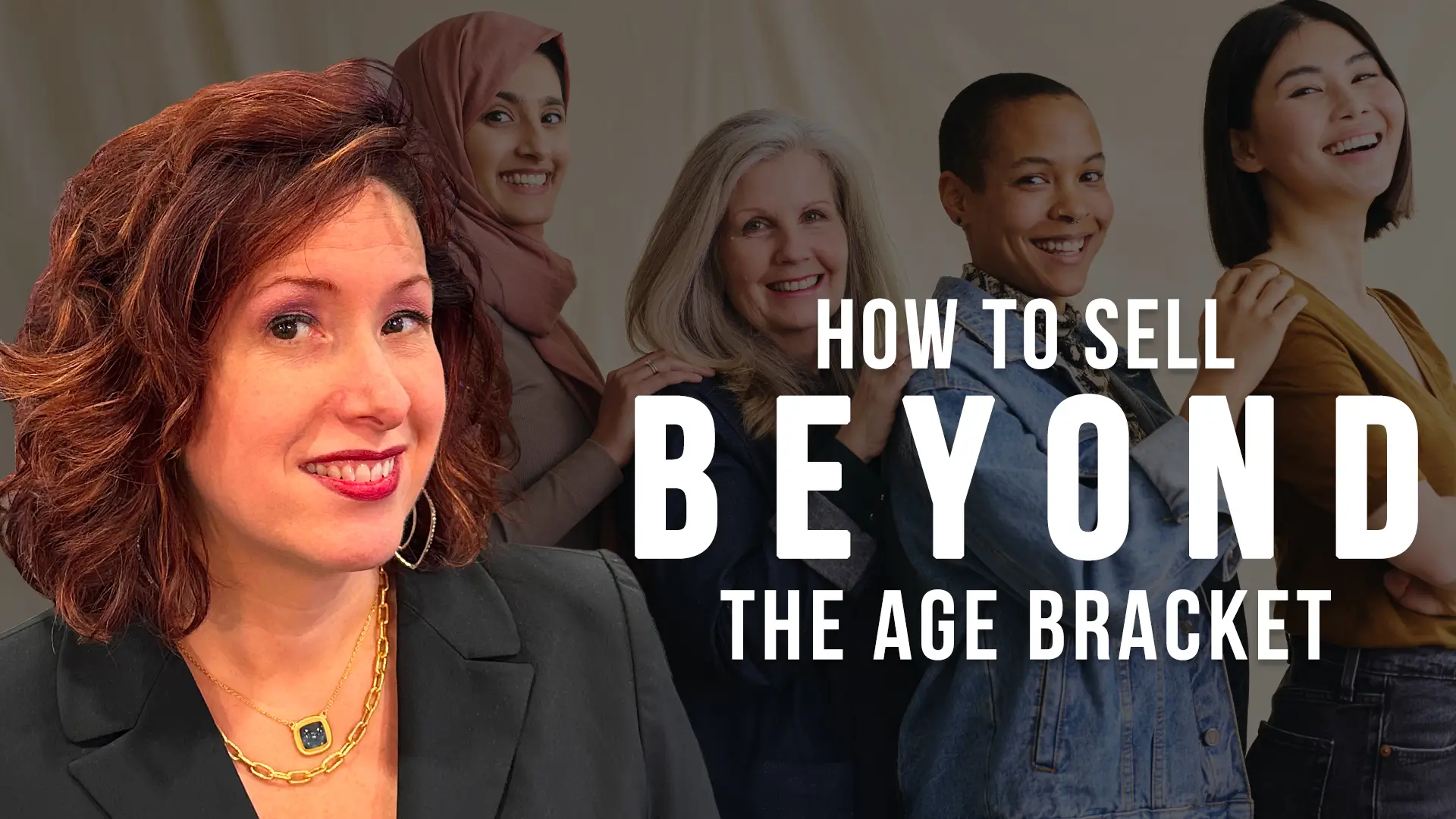
Your imagery should make customers feel welcome. But relevance doesn’t always come from matching the model’s age to the shopper’s.
Americans over 60 make up 22.2% of the population but just 4.2% of models in ads, according to a 2023 Journal of the Academy of Marketing Science review cited by Business of Fashion.
Our previous generational retail guidance emphasized showing customers people they recognize. The refinement is to consider shared style, interests, expertise, and aspiration alongside age.
The brands in the Business of Fashion article put their founders front and center. Frances Valentine co-founder Elyce Arons, in her 60s, is the brand’s primary model. Ulla Johnson’s highest-engagement content features its founder, in her early 50s, speaking directly to customers. Arons and Evereve’s Megan Tamte both see younger shoppers drawn to older women as style references. For an independent jeweler, the owner can play the same role.
These brands also put their biggest marketing spend behind Facebook and Instagram, not TikTok.
Review your photography and creator partnerships. Are you, by habit, showing a narrow age range? Are you choosing someone because they share your customers’ interests or simply because they were born in the same decade? Think this through and test who can communicate your sensibility more credibly.
Give Your Team Better Questions
The same thinking applies to sales conversations.
Instead of deciding, “That isn’t for someone her age,” train your team to ask:
“What do you want this piece to say about you?”
For a gift buyer:
“What does the person you’re shopping for wear most often?”
These questions leave room for discovery. They also give your marketing team better information than assumptions made from appearances.
Run One Sensibility Test Before Holiday Traffic Peaks
Choose one product category and one priority customers have expressed.
Build a small test around it: a collection, email, display, or product demonstration. Keep the products, pricing, and other conditions as comparable as possible.
Track qualified inquiries, product exploration, conversion, and sales, not likes alone. If you use a simple before-and-after comparison, treat the results as directional; other changes may have influenced them.
You don’t need to appeal to everyone.
You need to understand what brings the right customers together and make that connection easier to see.

Need Help Understanding What Your Customers Value?
Technology Therapy® Group can help you turn customer feedback, purchasing patterns, and marketing results into clearer priorities and practical tests for your online and in-store experience.